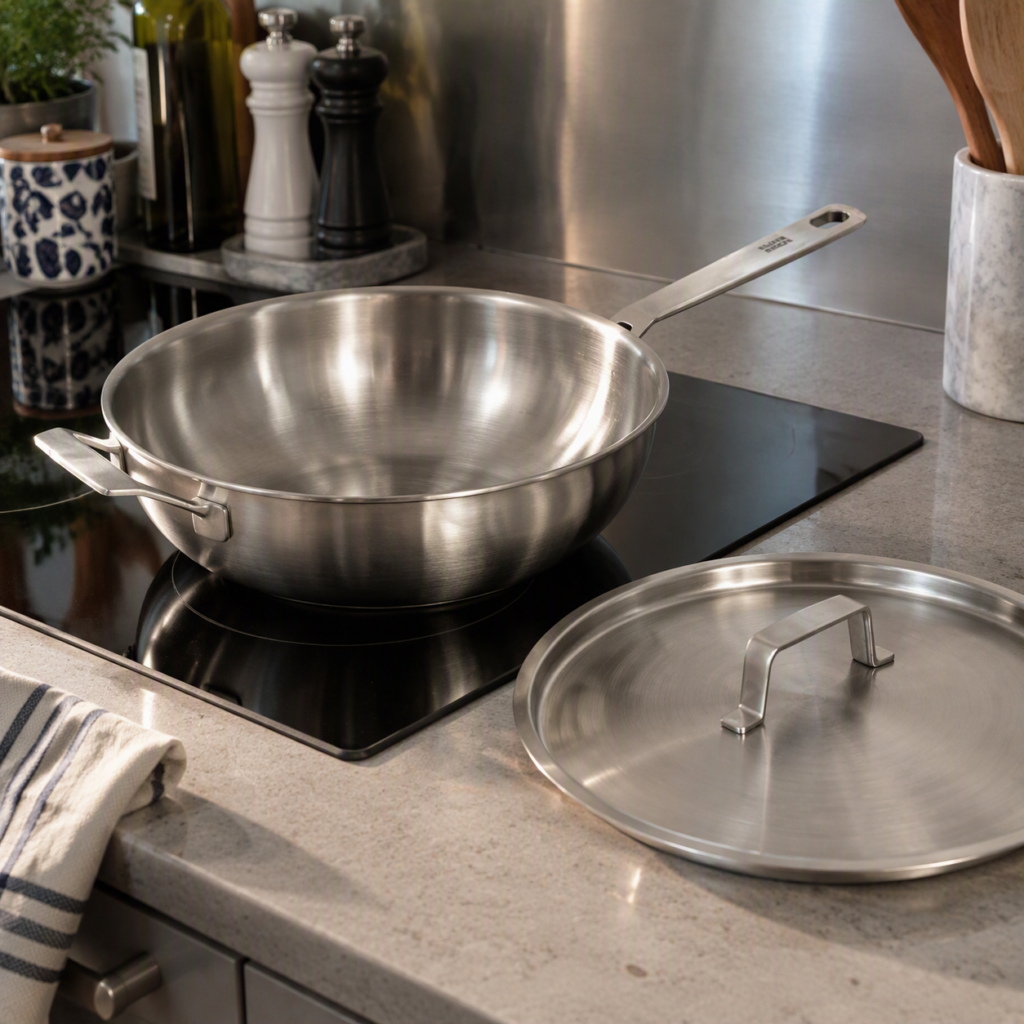
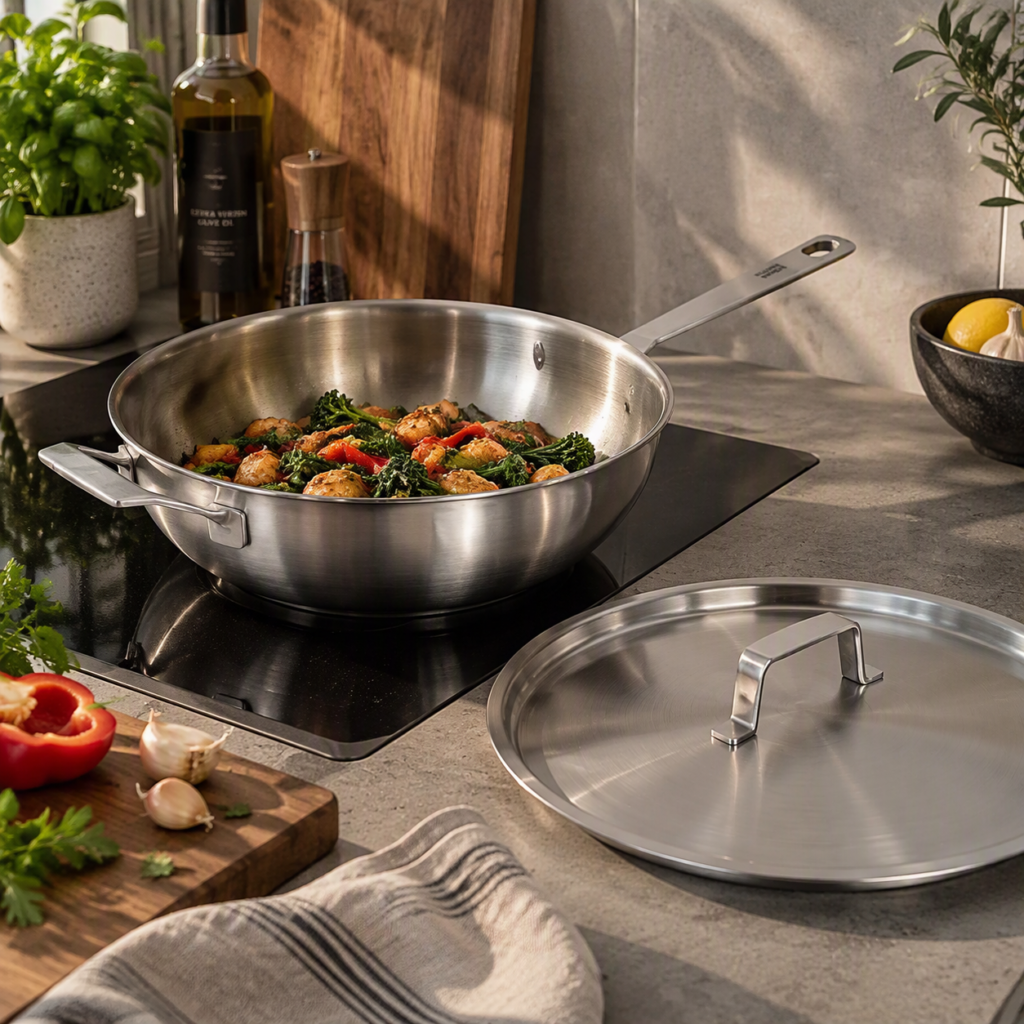
Engineering Architecture & First Impressions of Kuhn Rikon Culinary Fiveply Review
The Culinary Fiveply line from Kuhn Rikon doesn’t whisper for attention. It states its engineering case through mass and metallurgy. Pick up the 16cm/1.7L saucepan and the 1.18 kg heft registers immediately—this is a 3.2 mm bonded wall, not a stamped disc glued to a base. That distinction matters more than any marketing copy.
The Five-Ply Stack, Decoded The construction sandwiches three aluminum layers between two stainless steel skins. Aluminum moves heat laterally with near-zero resistance; stainless steel provides the durable, non-reactive cooking surface and the induction-ready exterior. The practical payoff is heat distribution that reaches the rim, not just the center. No ring of scorched fond around a pale middle.
For anyone who has fought a hot spot while reducing a sauce, that’s the whole ballgame. > Note: The 3.2 mm thickness is the spec worth memorizing. Thin pans warp under thermal shock; this gauge resists it, which is why the entire range—from the 20 cm frying pan to the 6.6 L cooking pot (SKU 37875)—carries a 240°C oven rating without hand-wringing.
First Impressions Across the Range – Saucepan, 16cm/1.7L: Balanced, with a 20.5 cm handle that stays cool on the stovetop. The stainless lid fits flush. – Frying pans, 20 cm and 24 cm (SKU 38501): Uncoated stainless surfaces. The 24 cm weighs 1.11 kg—enough to sit still on an induction hob, light enough for a wrist flick. – Serving pans, 24 cm/3.0L and 28cm/4.5L: The larger 28 cm model runs 2.43 kg and 39.8 x 29.7 x 11.5 cm, sized for oven-to-table service. – Cooking pot, 6.6L: 35.9 x 25.8 x 18 cm of stock-making real estate. Every piece is dishwasher safe and induction compatible.
If you’d like the full range breakdown, please check the company’s official website for current availability. The Uncoated Reality These pans are bare stainless. Real user feedback confirms the classic learning curve: food sticks when the pan isn’t hot enough, and impatience makes it worse. Preheat properly, let proteins release on their own schedule, and the surface performs. The architecture rewards technique—it doesn’t compensate for its absence.
Exclusive Proprietary Specifications & Materials Breakdown
The Culinary Fiveply line is not a marketing exercise in slapping “premium” on a box. It is a metallurgical sandwich, and the numbers tell you exactly why it behaves the way it does on your hob. At the core sits a 3.2 mm bonded wall: three inner layers of aluminium clad between two outer layers of stainless steel.
That aluminium is the thermal engine — it moves heat laterally with almost no resistance — while the steel skins provide the durability, the induction response, and the food-safe surface. The payoff is stated plainly in the spec sheet: even heat distribution right up to the rim. Translation for the home cook: no more pale ring around the edge of your sauce and a scorched bullseye in the middle. > Note: Every piece in this range is uncoated.
There is no chemical non-stick layer to flake, scratch, or replace. Your release comes from heat management and fat, not from a coating.
| Product | SKU | Diameter | Capacity | Weight | Oven Max | |—|—|—|—|—|—| | Saucepan | — | 16 cm | 1.7 L | 1.18 kg | 240 °C | | Frying Pan | — | 20 cm | — | — | 240 °C | | Frying Pan | 38501 | 24 cm | — | 1.11 kg | 240 °C | | Serving Pan | — | 28 cm | 4.5 L | 2.43 kg | 240 °C | | Cooking Pot | 37875 | — | 6.6 L | — | 240 °C | | Serving Pan | — | 24 cm | 3.0 L | — | 240 °C | Cross-compatibility matrix: induction ✓ | gas ✓ | electric ✓ | ceramic ✓ | oven to 240 °C ✓ | dishwasher ✓. That 240 °C ceiling matters. It clears virtually every roasting and braising task you’ll attempt, but it is a hard line — exceed it and you risk warping the bond.
The 24 cm frying pan’s 1.11 kg heft is deliberate: mass equals thermal stability, so the pan doesn’t lurch when cold protein hits it. This is the powered advantage of five-ply over stamped discs — the whole vessel, walls included, is the heating element. Think of it as an anubis-grade conductor: a guardian of heat that refuses to let hot spots through. The solution to uneven cooking isn’t a gadget; it’s geometry.

Daily Workflow Performance, Burr Alignment & Testing
The 3.2 mm five-ply wall—two stainless skins sandwiching three aluminum layers—isn’t marketing garnish. It’s the reason a 16 cm/1.7 L saucepan at 1.18 kg feels planted rather than tippy, and why heat climbs the sidewalls instead of pooling in the base. That lateral conduction matters more than most cooks realize: when you sear in the 24 cm frying pan (SKU 38501, 1.11 kg), the rim runs nearly as hot as the center, so fond develops edge-to-edge rather than in a timid bullseye. > Note: The single biggest cause of sticking in these uncoated pans is insufficient preheat. Bring the metal up to temperature before food lands, and give proteins a full 60–90 seconds untouched.
The surface releases when a proper crust forms—not when you poke at it. Alignment check, kitchen edition. Before each session, verify the pan sits flat on your induction zone. A 0.5 mm warp—invisible to the eye—kills the magnetic connection and creates a hot ring with a cold core. Spin the pan on a granite counter; any wobble means it’s time to let the metal cool and re-seat it, never to hammer it flat. Testing protocol for new owners: – Water bead test: Heat the 20 cm pan dry over medium. Flick droplets in. If they skate and sizzle, you’re at searing temperature. If they hiss and vanish instantly, back off. – Onion transparency: Sweat diced onion in the 3.0 L serving pan (Ø 24 cm). Even browning across the full base confirms the aluminum core is doing its job. – Oven handoff: All pieces are rated to 240°C, so a stovetop sear in the 28 cm/4.5 L serving pan can slide directly into a 220°C oven without a pan change. Just confirm your handle stays cool enough to grab—or use a dry towel.
Cleaning without wrecking the surface. Dishwasher-safe, yes, but the uncoated steel will develop a patina. That’s cosmetic, not damage. For stubborn fond, deglaze with water while the pan is still warm—the thermal shock does the scrubbing for you. One quirk worth knowing: if your browser blocks scripts (no-js environments), retailer spec pages may hide capacity figures. Cross-check against the physical stamp on the base. And if a pan arrives with a changed handle rivet or a loose connection at the weld, that’s a warranty conversation, not a DIY fix.
Known Limitations, Community Issues & Friction Points
The Culinary Fiveply line earns its 4.5-star average across 61 verified reviews, but that half-star gap tells a story worth unpacking. Most friction traces back to one design reality: this is uncoated stainless steel, and it behaves nothing like the nonstick pans many home cooks are migrating from. > Note: The single most common complaint—food sticking—almost always traces to insufficient preheating, not a manufacturing defect.
The 3.2 mm five-ply body needs a genuine 2–3 minute warm-up before proteins hit the surface. The Learning Curve Is Real – Sticking and premature flipping. Community threads repeatedly flag cooks moving food too soon. Stainless releases when a Maillard crust forms; force it early and you’re scraping. This isn’t a flaw—it’s physics. – Weight as a tradeoff. The 28 cm serving pan tips the scale at 2.43 kg, and the 6.6 L cooking pot (SKU 37875) isn’t lighter. That mass delivers the even heat distribution right up to the rim, but it’s genuinely taxing for anyone with wrist or grip limitations. – Handle heat.
The 20.5 cm handle on the 16 cm saucepan stays cooler than riveted competitors, yet long stovetop sessions still conduct warmth. A towel becomes non-negotiable. Dishwasher Reality Check While every piece is rated dishwasher safe, the past decade of owner feedback suggests detergent and high-temp cycles dull the mirror finish over time. Hand washing preserves the aesthetic; the dishwasher preserves your evening.
Service Friction Scattered reports describe pan issues requiring customer service intervention—though the same reviewers consistently praise the speed of resolution. The pattern suggests occasional QC variance rather than systemic failure. What’s Missing – No helper handles on the larger vessels, which compounds the weight issue – No capacity markings inside the pots – The 240°C oven ceiling rules out broiler-finishing at maximum heat The Honest Verdict These aren’t defects so much as the cost of admission for uncoated, induction-compatible, five-ply cookware. The loading of expectations matters: buy these understanding you’re trading convenience for searing performance and longevity. Do that, and the friction points shrink to footnotes.
Verdict: Who Should Buy This Setup in 2026?
If you have ever watched a stainless pan sadly weld a salmon fillet to its surface, the culprit is rarely the cookware. It is heat management. The Kuhn Rikon Culinary Fiveply line sidesteps that frustration with a genuinely overbuilt foundation: a full 3.2 mm five-ply wall, sandwiching three aluminum layers between two stainless skins, delivering heat evenly right up to the rim. That rim-to-rim consistency is the quiet engineering win here, and it changes who this set makes sense for.
Buy it if you fall into these camps: – Induction holdouts who refuse to compromise. Every piece, from the 16 cm/1.7 L saucepan (1.18 kg) to the 28 cm/4.5 L serving pan (2.43 kg), is induction-compatible. No magnetic disc gimmicks, no hot spots. – Oven-to-table cooks. All vessels are oven safe to 240°C, so a frittata in the 24 cm frying pan (SKU 38501, 1.11 kg) or a braise in the 6.6 L cooking pot (SKU 37875) moves from hob to oven. – Dishwasher pragmatists.
Uncoated stainless plus dishwasher-safe construction means no delicate nonstick layer to baby. Scrub it, rack it, move on. – Social cooks who plate at the table. The 3.0 L serving pan (Ø 24 cm) and 4.5 L version exist precisely for the stand-and-serve moment, and their weight signals serious thermal mass. Skip it if: – You want lightweight pans for tossing. At 1.11 kg for a 20 cm frying pan, these are dense. – You rely on nonstick release for eggs. Uncoated steel demands proper preheating; the most common user complaint is food sticking because the pan was not hot enough, not because the pan failed. – You need a full matched stand-alone set out of one box.
This is a modular lineup, not a curated bundle. With verified ratings hovering around 4.5 stars and responsive customer service resolving pan issues quickly, the Culinary Fiveply rewards patience and technique. In 2026, that is a fair trade for cookware that will likely outlast your kitchen.
Frequently Asked Questions
Are Kuhn Rikon stainless steel pans good?
Kuhn Rikon stainless steel pans, such as the Culinary Fiveply line, feature 5-ply construction with an aluminum core for even heat distribution and are oven safe up to 240°C and dishwasher safe. They are compatible with all hob types, including induction.
What carbon steel pan does America’s Test kitchen recommend?
America’s Test Kitchen has recommended the Matfer Bourgeat Black Steel Round Frying Pan as a top carbon steel pan. However, recommendations may change over time, so it’s best to check their latest reviews.
Which is better, Tefal or Circulon?
Both Tefal and Circulon offer a range of non-stick cookware, and the better choice depends on individual needs such as budget, preferred materials, and cooking style. Tefal is known for its Thermo-Spot technology, while Circulon is recognized for its durable non-stick surfaces.
Which Kuhn Rikon pressure cooker is best?
Kuhn Rikon offers several pressure cooker lines, including Duromatic and Duromatic Inox, which are highly regarded for their Swiss engineering and safety features. The best model depends on capacity needs and stovetop compatibility.