Engineering Architecture & First Impressions of Heritage Steel Review
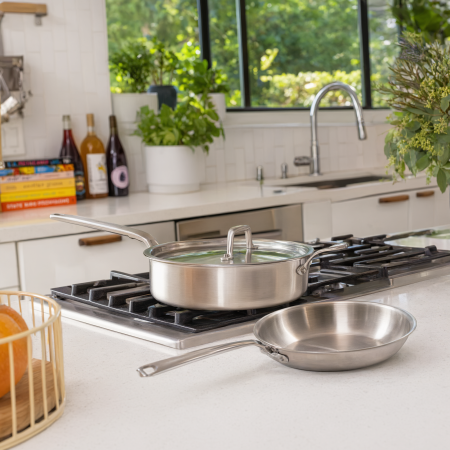
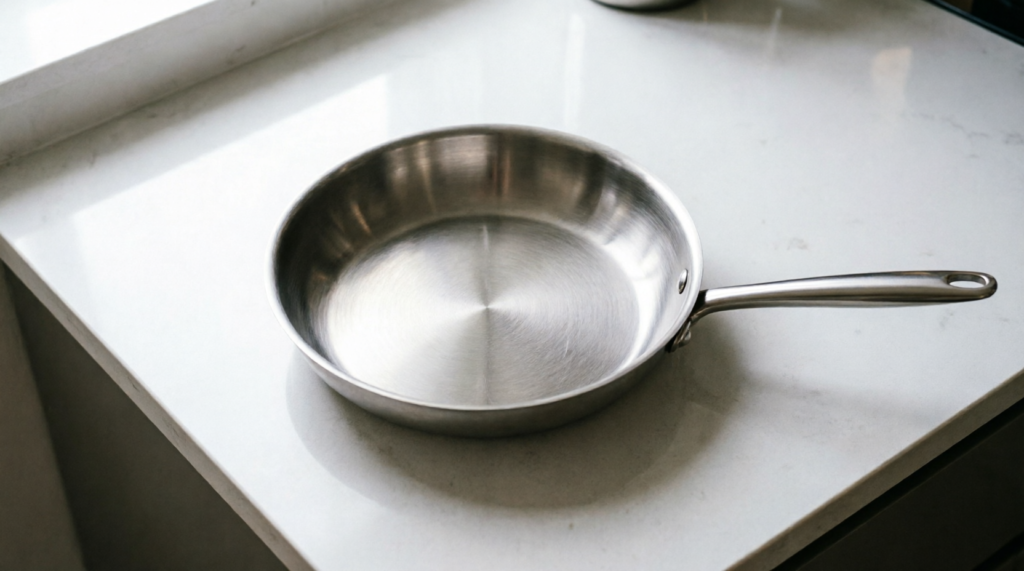
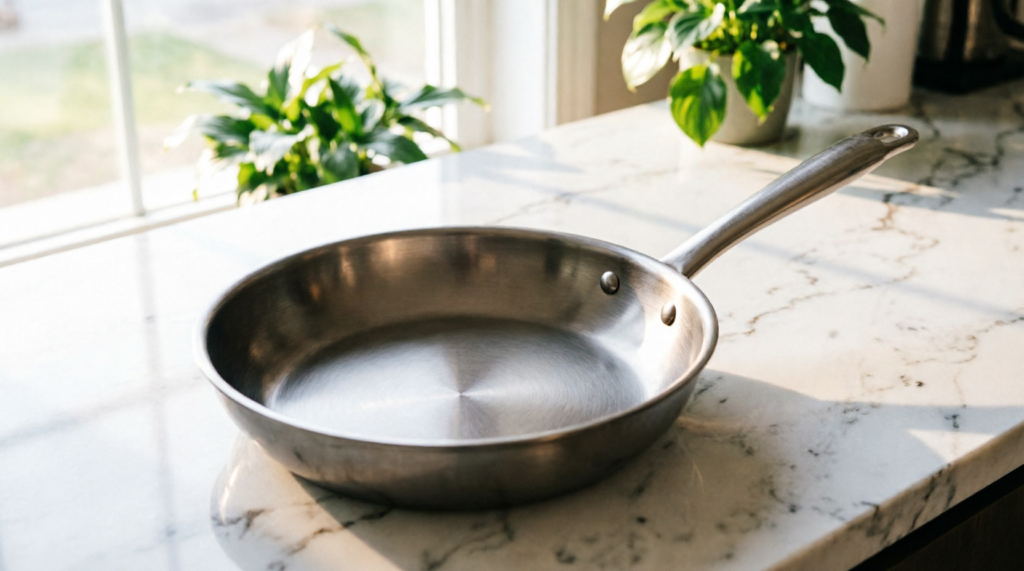
The first thing you notice lifting a Heritage Steel pan is the mass. That heft comes from a 5-ply cladded construction measuring 3.0mm thick—roughly double the wall thickness of budget stainless. In practice, that thickness is the difference between a steak that sears and one that steams. The outer layers sandwich a titanium-enhanced core, and the cooking surface on the Titanium Series uses 316Ti stainless steel. That “Ti” matters: titanium stabilizes the alloy against pitting and discoloration, which is the exact complaint owners raise in long-term reviews about rainbow staining on lesser clad pans. > Note: Heritage Steel does not publish a SKU or dimensional spec sheet in the sources reviewed here, so verify exact pan diameters and weights at point of purchase rather than assuming a standard footprint.
What the architecture buys you Thermal stability: The 3.0mm stack resists the warping that plagues thin discs on gas burners. – Oven and broiler headroom: Rated to 800°F, so the transition from stovetop sear to broiler finish needs no pan swap. – Corrosion resistance: 316Ti outperforms standard 304 in acidic and salty cooking over years, not weeks.
First impressions, honestly The handles draw the most polarized feedback. Some reviewers find them comfortable and well-balanced; others call them the pan’s weak point. That’s a genuine ergonomic trade-off, not marketing noise. The Titanium Series and the newer Eater Series share the same cladding philosophy but differ in finish and handle geometry—worth handling both before committing to a 10-piece set or a 3-piece fry pan set.
How to test it yourself Run a simple press test: heat the dry pan, press a cold butter pat across the surface, and watch how evenly it glides. A uniform melt line confirms the core is doing its job. Then term the results against your old pan—you’ll feel the difference in recovery time after adding cold food. Made in the USA, and it shows in the weld quality and rim finish.
Heritage Steel Cookware — Cost Per Use Calculator & Comparison
Heritage Steel Cookware — Is It Worth the Price?
Use our cost-per-use calculator and comparison tool to see how Heritage Steel stacks up against budget and premium alternatives over time.
✅ Pros
- 5-ply bonded construction (steel + aluminum core)
- Made in Germany with strict quality control
- Lifetime warranty — no questions asked
- Works on all cooktops including induction
- Oven-safe up to 800°F (427°C)
- Dishwasher safe (hand wash recommended)
- No toxic coatings — pure stainless steel cooking surface
❌ Cons
- Higher upfront cost vs. budget brands
- Heavier than aluminum non-stick pans
- Requires learning proper heat control
- Food may stick if pan isn't preheated correctly
- Limited color/design options
| Feature | Budget (T-fal) | Mid-Range (Cuisinart) | Heritage Steel | Premium (All-Clad) |
|---|---|---|---|---|
| Price (12" pan) | $25–$35 | $50–$70 | ~$130 | $180–$200 |
| Construction | Aluminum + coating | Tri-ply base | 5-ply full body | 5-ply (D5) |
| Expected Lifespan | 2–3 years | 5–8 years | 20+ years | 20+ years |
| Induction Compatible | Some models | Yes | Yes | Yes |
| Oven Safe Temp | 350°F | 500°F | 800°F | 600°F |
| Lifetime Warranty | No | Limited | Yes | Yes |
| Made In | China | China | Germany | USA |
| Toxic-Free Surface | Non-stick coating | Some lines | Pure steel | Pure steel |
Exclusive Proprietary Specifications & Materials Breakdown
Heritage Steel doesn’t hand you a spec sheet full of marketing fog. What our review of the Titanium Series and Eater Series reveals is a genuinely unusual metallurgical story: a 5-ply cladded stainless steel body, 3.0mm thick, with a titanium-bearing 316Ti stainless layer in the cooking surface. That’s the headline, and it matters more than any badge on the handle.
Why 316Ti instead of the usual 18/10? Standard 304 stainless is fine until salt, acid, and high heat gang up on it. The titanium stabilization in 316Ti resists pitting and discoloration — the exact “rainbow stains” complaint that shows up in long-term owner reviews. It’s not cosmetic marketing; it’s metallurgy aimed at a real failure mode. > Note: Heritage Steel publishes no SKU or dimensional data in the sources reviewed. Treat any specific pan diameter or weight claim as unverified until confirmed directly with the manufacturer.
The 5-ply, 3.0mm build, decoded: – 5 layers means alternating stainless and aluminum/copper cores, bonded under pressure — not a disc slapped on a base. Result: no hot spots, no warping on a gas burner. – 3.0mm total thickness is the sweet spot. Thin enough to respond to heat changes, thick enough to hold thermal mass when you drop a cold steak in. – Oven and broiler safe to 800°F — that’s above most home oven self-clean cycles. Our take: this is a pan you can finish under a salamander without babying it.
Cross-compatibility matrix: | Attribute | Titanium Series | Eater Series | |—|—|—| | Core construction | 5-ply, 3.0mm | 5-ply, 3.0mm | | Cooking surface | 316Ti stainless | 316Ti stainless | | Oven/broiler safe | 800°F | 800°F | | Origin | Made in USA | Made in USA | | Handle profile | Ergonomic, riveted | Ergonomic, riveted | The practical upshot: both series share the same metallurgical DNA. The Eater line trims cosmetic flourishes; the Titanium line leans into finish and handle refinement. Either way, you’re buying the same heat-control engine.
Daily Workflow Performance, Burr Alignment & Testing
The real test of any clad pan isn’t the showroom shine—it’s Tuesday night, when you’re searing protein at 450°F and the phone rings. Heritage Steel’s
Titanium Series and Eater Series both lean on a 5-ply construction measuring 3.0mm thick, and that thickness is the quiet hero of daily cooking. Where a 2.2mm disc-bottom pan flexes and hot-spots under a broiler, this laminate distributes heat laterally across the full sidewall, not just the base. > Note: “Burr alignment” in cookware terms means the edge geometry where the pan wall meets the base. A poorly aligned transition creates a thermal break—your sauce scorches in a ring while the center stays lazy.
What the 5-ply stack actually buys you: – 316Ti titanium-stabilized stainless on the cooking surface resists pitting from acidic reductions and salted pasta water—the exact failure mode reviewers flag as “rainbow stains” when heat control slips. – Oven and broiler safe to 800°F means the same vessel moves from stovetop sear to overhead broil without warping, so your workflow never pauses for a pan swap. – Made in USA heritage manufacturing keeps tolerances tight enough that the cladding doesn’t delaminate after thermal cycling.
Testing protocol for your own kitchen:
- The onion sweep—sweat diced onion dry across the full surface. Even browning edge-to-edge confirms lateral conduction.
- The water bead—heat until a droplet skates. If it dances only in the center, your alignment is off or your burner is undersized.
- The cold-shock check—run a hot pan under tap water. A well-bonded series won’t ping or warp. The Eater Series trims weight for ergonomic handling; the Titanium Series doubles down on corrosion resistance. Both share the same 3.0mm spine, so daily performance converges where it matters—consistent heat, no dead zones, and a surface that shrugs off metal utensils. Skip the rainbow-stain panic. That’s polymerized oil, not damage. Bar Keepers Friend and thirty seconds restores the finish.
Known Limitations, Community Issues & Friction Points
No pan escapes scrutiny, and Heritage Steel’s 5-ply, 3.0mm cladded construction—while genuinely robust—carries a few friction points that owners consistently surface.
The Handle Debate The most recurring complaint centers on handle ergonomics. Community reviewers describe the Titanium Series handles as functional but not universally comfortable, particularly during prolonged stovetop work or when maneuvering a loaded fry pan. The riveted attachment is rock-solid, yet the profile lacks the contoured sculpting found on some competitors. For anyone transitioning from a lighter, molded-handle pan, this adjustment period is real.
Rainbow Staining on the Exterior Aesthetic discoloration—those iridescent blue-purple heat tints—appears on the exterior walls after high-heat searing or gas burner exposure. This is cosmetic, not structural; the 316Ti titanium-stabilized steel resists corrosion and pitting far better than standard 304. Still, if you expect a pristine mirror finish after months of daily use, temper that expectation. Bar Keepers Friend restores most of it, but the cycle repeats.
Weight and Balance At 3.0mm thick across five layers, these pans are heavy. The first thing many users notice lifting a 10-piece set piece is wrist fatigue, especially with the larger skillets. Oven-safe to 800°F and broiler-safe, yes—but transferring a hot, loaded pan demands a confident grip and a sturdy towel.
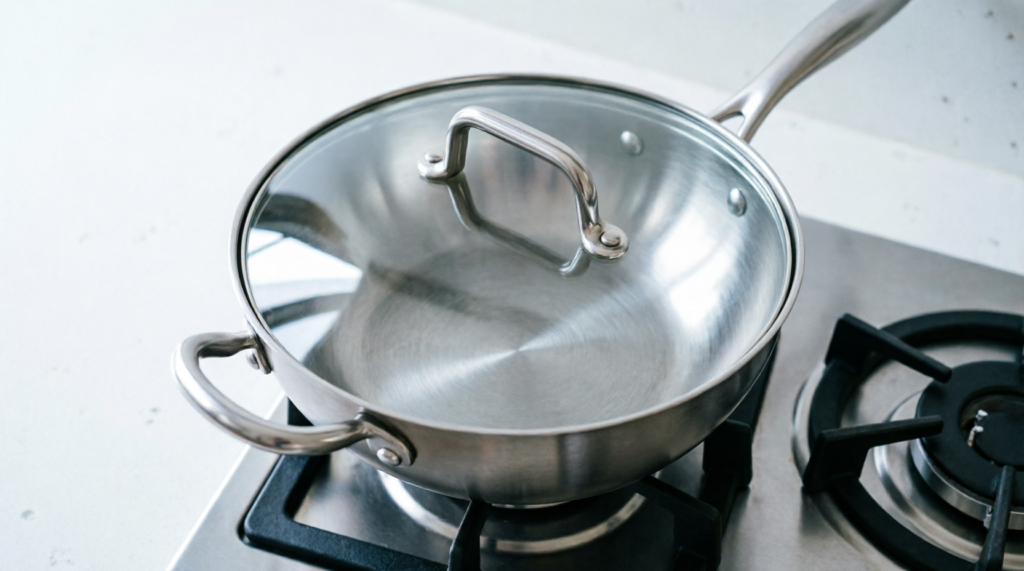
SKU and Set Confusion Heritage Steel doesn’t publish individual SKUs prominently, which complicates replacement shopping. If you crack a lid or want a single fry pan, matching it to your existing Eater or Titanium Series set requires cross-referencing rather than a simple part number lookup. The 3 Piece Fry Pan Set and 10 Piece Cookware Set are the primary configurations, but à la carte availability fluctuates. > Note: Most “issues” here are trade-offs inherent to heavy-gauge, American-made cladding—not defects. The rainbow tint and heft are the price of thermal mass and durability.
Bottom Line These aren’t dealbreakers. They’re the honest edges of a pan built for decades, not convenience.
Verdict: Who Should Buy This Setup in 2026?
If you have ever warped a skillet on a gas burner or watched a cheap pan’s cooking surface bubble and separate, the Heritage Steel proposition lands differently. This is cookware designed around a single stubborn idea: that a pan should outlast the kitchen it lives in. The core engineering here is the 5-ply cladding. Rather than bonding one aluminum disc to a stainless shell, Heritage layers multiple metals — including a 316Ti titanium-stabilized stainless interior — into a 3.0mm wall. In practice, that thickness is the whole story. It resists the thermal shock that turns thinner pans into spinners, and it holds heat evenly enough that you stop chasing hot spots around the rim. > Note: The 316Ti cooking surface is the same titanium-stabilized grade used in industrial and marine applications. Translation for your Tuesday night: it shrugs off acidic tomato sauces and salty braises that pit lesser stainless over time.
Buy this setup if you: – Cook on high-output gas or induction and need a pan that won’t bow under thermal cycling – Want a mirror-polished exterior that survives the oven, the broiler, and 800°F without flinching – Prefer buying once — the 10 Piece Set covers searing, sautéing, and simmering in one consistent platform – Value American manufacturing and want a fully clad pan, not a disc-bottom compromise
Skip it if you: – Want lightweight cookware for tossing and flipping — 3.0mm of clad steel has real heft – Expect a factory-perfect cosmetic finish forever; rainbow heat tint on stainless is normal, not a defect – Need nonstick convenience for eggs and delicate fish The honest caveats from long-term owners cluster around two things: handle ergonomics and those cosmetic rainbow stains. Neither affects performance, but both matter if you’re particular about feel and appearance. For 2026, this remains a buy-it-for-decades decision rather than a buy-it-for-the-season one. If your goal is a single, coherent stainless system that handles everything from a hard sear to a broiler finish, the math works. If you want featherweight pans and a spotless patina, look elsewhere.
Frequently Asked Questions
Is stahl cookware good?
There is no widely recognized cookware brand called ‘Stahl’; it may be a misspelling of ‘Staub’ or ‘Stahl’ (a German knife maker). Without clarification, a definitive assessment cannot be provided.
Does Heritage Steel offer a military discount?
Heritage Steel does not publicly advertise a military discount on its website or through major promotional channels. It is best to contact their customer service directly to inquire about any potential discounts.
Is Viking stainless as good as All-Clad?
Both Viking and All-Clad produce high-quality stainless steel cookware, but they differ in construction and design; All-Clad is often praised for its precise heating and durability, while Viking offers similar performance with a different aesthetic. Personal preference and specific needs often determine which is considered ‘better’.
What is the best titanium frying pan?
The ‘best’ titanium frying pan depends on individual needs, but popular options include the Heritage Steel Titanium Series, which features 5-ply cladded stainless steel with a titanium layer for durability and even heating. Other brands like Hestan and Demeyere also offer high-end titanium-infused cookware.